
The I’M A GIRLY dolls
Is there such a thing as ‘too girly’?
That’s the question we were asking ourselves when some people took issue with the name of a Swiss fashion doll being launched in the UK, which we’re working with. The brand is called I’M A GIRLY.
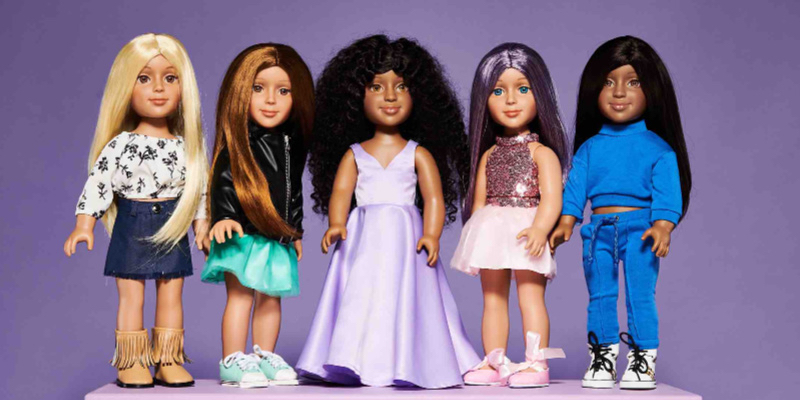
It’s this word ‘girly’ that’s triggered responses, rather than the dolls themselves. After all, the range of 5 dolls — put together by a mother and entrepreneur — features realistic proportions and a range of hair colours, hair textures and skin tones. The trendy accessories for the dolls range from trainers, horn-rimmed glasses and jean jackets to faux fur coats, llama pyjamas and silver sandals. The ambitions of the dolls range from being a vet in Africa to an astronaut to a gymnast.
As parents we like that toy aisles are moving away from the stereotypical pink-for-girls-blue-for-boys. We want toys these days that let our children develop their interests and explore through play. Any child can play with any toy.
But does it follow that every toy has to do everything? Must every toy broadcast the message that all children and indeed all people are alike in every way?
It’s natural and right that as parents and as a society that we don’t want children put in a box because of their gender. But at the same time, there’s nothing wrong with noticing that children enjoy different activities. We understood the name I’M A GIRLY to refer to the dolls themselves — the dolls are all girls — rather than the children who own them. (The company develops the dolls and accessories using a panel of girls and boys aged 9 – 13. The high-end fashion-dolls are available at Harrods and Hamleys. If you’re interested in being among the first to see and style the dolls, check out this exclusive event!)
“I’M A GIRLY is not about gender, rather it’s a feeling or expression,” says founder Theresia Le Battistini, who notes the name hasn’t provoked any controversy in its native Switzerland.

Kayla, left, loves playing volleyball. Lola, top, wants to be an actress. Zoe is a hippie chick.
We can’t help but wonder as well if there’s a whiff of unconscious bias in reactions to a doll aimed that celebrate the ‘girly’ and what are considered traditional ‘girly’ leisure interests. It reminds us of the way until quite recently an interest in fashion was considered less important or serious than a similar interest in, say, cars. Many ask, ‘What’s wrong with a toy that allows children to dress up a doll and do its hair?’ — like parents do with children and an activity many of our us enjoyed as children and with our children. We like that with I’M A GIRLY, children can play with a doll whose proportions, skin tone and hair texture resemble their own.
Which leads us to our next question. Of course playing with dolls isn’t only for girls. Wouldn’t it be great to imagine a boy picking up fashion-doll Jasmine (loves her golden retriever) or Lucy (wants to be an astronaut) and not feeling like playing with his ‘Girly’ makes him any less of a ‘boy’.
From its inception, BritMums has been a feminist organisation — promoting equality of opportunity between men and women and between mothers and fathers. We’ve written about tax breaks for childcare (just like you get for your chauffeur!), championed dads to be as much as part of the parenthood conversation as mums, and proudly worn the label ‘feminist’ when it was common a few years ago to say, ‘I’m not a feminist but…’.
We are feminists and we think it’s great to celebrate children and their interests. That includes being a girl, being a boy, being any way you want to be.
Disclosure: BritMums is working with I’M A GIRLY in a paid relationship. All opinions are our own.

About Jennifer Howze
Jennifer Howze is the Creative Director and co-founder of BritMums. She blogs about family travel at Jenography.net, tweets at @JHowze and Instagrams at @JHowze. Previously, she wrote the Alpha Mummy blog at The Times and as a journalist has contributed to The Times, The Guardian, The Independent, The Wall Street Journal, Travel & Leisure, Budget Travel, CNN.com, Allure, SELF and Premiere, among others. She won The Maggie Award from the Planned Parenthood Federation of America for a health article in Seventeen magazine.
Roxanne-Sasha | The Resilient Mum
Monday 12th of November 2018
Fab post! I like that the range of dolls is diverse and features dolls with various hair colours and hair textures as well as different skin tones. It is nice for children from different backgrounds to be able to discover dolls that they feel they can relate to, or appear to look similar to them.
My daughter has moments where she loves to dress up as a princess or even days where she decides she will be a superhero, stating with pride that she is, "Batman" or "Superman." I am very much into Superheroes myself (as a fan of action films) and I have told her that there is a Batgirl and a Supergirl too. Although, I have no issue with her exploring and I leave her to do so. I adopt this approach because she is a free spirit, so I support this by not restricting her (unless she is in danger of getting hurt.)
I have no issue with the word "girly" and feel that although it may have negative connotations to some, children should be free to play with what interests them. Their imagination is one of their greatest tools and it should be enhanced by allowing them to access a wide range of toys, play opportunities, etc.
Joy Ejaria
Monday 12th of November 2018
Girly is not a word I would use to describe my daughters however, that's not because I have a problem with the word. It's more to do with the fact that they are not stereotypical girls. I think nowadays we are all a bit touch about everything. Gone are the days of free speech. You now really have to watch what you say, where you are when you say those things etc. It's crazy. Just because it has such a name doesn't mean they are alienating boys from enjoying the toys... I'm just happy a toy company has come out with a diverse range!
Rebecca | AAUBlog
Sunday 11th of November 2018
I really enjoyed the post, and sometimes when we see things with our 'grown up' eyes, we over think things. The range of dolls is great, and there will be one for each child, and that each child can relate to. Boy or girl.
JuggleMum, Nadine Hill
Sunday 11th of November 2018
I don't think we need to re-think the word 'girly' - what's wrong with being a girl? This doll range of female dolls calls itself 'I'm A Girly' but that is what it is, descriptive. However the aspirations and appearances of these dolls doesn't confirm to gender stereotypes - one of them wants to be an astronaut or write her own music. I think rather than being hung up on one aspect of the range - the name, we should be celebrating the fact that this is a range of dolls with different shade of skin and solid body types - i.e. not the old fashioned kind of 'skinny but curvy in all the right places' kind of dolls I grew up with in the '70s which reinforced the 'you must be skinny to be worthy' message I felt growing up. These dolls are fashion dolls for the 21st century, and with the fashion industry being worth nearly £21 billion directly to the UK economy (source: British Fashion Council) as an ex fashion student, I for one think this is something exciting.
Charlene Brown
Saturday 10th of November 2018
Nice dolls that have cool accessories, clothes, varying skin tones as well as interesting and diverse back stories. Don't really understand the "gender stereotyping", inevitably there will be some pink and sparkle in any range of dolls. With my daughters there was a definite "pink and sparkle" one as well as a "not bothered with pink" one.
It will always be the imagination of the child playing with the doll that will either continue the back story or create a new one. All one can do is to allow for a child to have the opportunity to play with dolls that reflect the diversity around us and realistic aspirations. How the child carrys on the story is really up to them. Bring on more cool and interesting dolls!
Jennifer Howze
Sunday 11th of November 2018
Charlene, I like the idea of how a child plays with dolls (or any toy) is up to them. (Probably why the boxes that presents come in are so compelling to kids, sometimes rivalling the toys themselves.) Perhaps one of the reasons we see dolls that are all very similar is that the industry is dominated by big manufacturers. More individual makers and entrepreneurs could help expand the offering so eventually we have dolls that better reflect the families who buy them.