
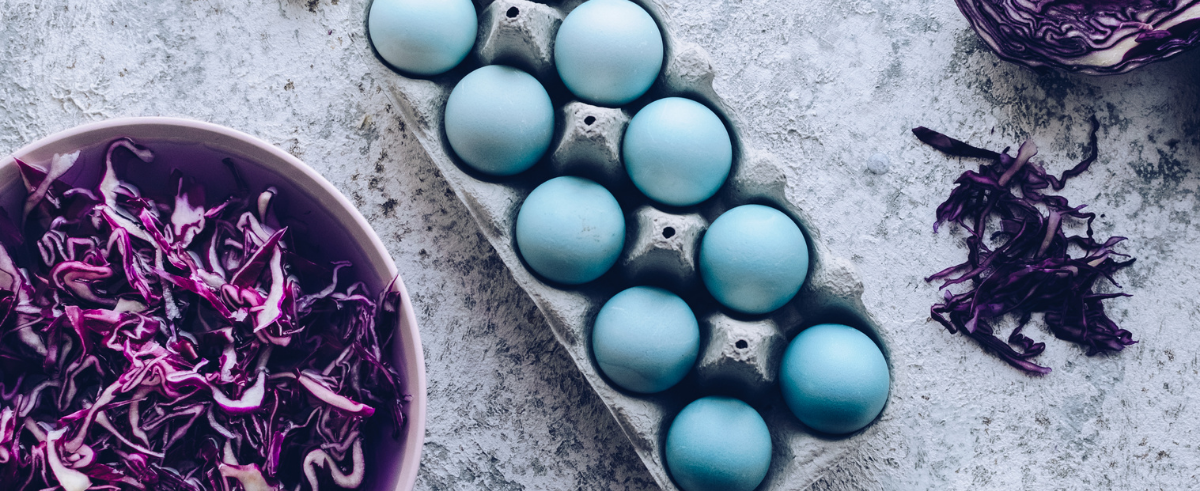
With Easter approaching I thought I would have a go at something different craft wise: naturally dyed eggs. These make cute decorations and as it turns out, learning how to dye Easter eggs with natural ingredients is actually pretty simple to do. I have seen some amazingly intricate designs on Pinterest and with a bit of time and effort I am sure I could get some amazing results.
It took a little bit of experimenting but there are plenty of natural dyes that you can use. Red cabbage, beetroot, turmeric, spinach, onion skins, tea – each gives its own unique colour to the egg. The great thing is too that you can dye easter eggs without a kit — just with natural ingredients you have at home. You can also create some pretty special easter egg designs using plants.
After a few experiments of my own, I have come to the conclusion that if you can try and use white eggs you will get a better result, I used your average brown ones. You can just dye your eggs as they are but I wanted to try and add a botanical pattern to mine.
What you need to dye Easter eggs
- Eggs (however many you want to dye)
- White vinegar (this helps the dye bond to the shell)
- An old pair of sheer tights
- String
- A few pots or tubs
- Natural dyes (I am going with red cabbage and turmeric)
- Daisies or small leaves, herbs to produce the pattern

How to dye Easter eggs
A big question for many people is, Do I have to hard boil eggs before dyeing them? I’ve been told it is best to hard boil your eggs first and then set them aside to cool down. Hard boiled eggs are easier to handle and obviously less prone to breaking while dyeing.
What natural ingredients are best for dyeing eggs?
I have found out that red cabbage works really well as a natural dye: It gives a deep blue colour. (Yes, blue!) I boiled a few slices of red cabbage in water with a cap full of white vinegar for about 30 minutes. You are left with a rich purple colour liquid.
With the small leaves that I had picked outdoors, I brushed on some white vinegar to the egg shell to help the leaves stick. I then cut a piece off of an old pair of tights and wrapped the egg up and tied it with string.

I then left the eggs to soak in the purple liquid over night.

I repeated the above technique using turmeric and onion skins too just to see how it would turn out, a added a dandelion head flower to this one.
The following morning I removed the eggs from the dye and took the tights off them, then gently peeled away the leaves and this is what I was left with. Pretty satisfying hey!?

Some people polish them up with a bit of olive oil and display them in lovely baskets. As mentioned, the results probably would have been more intense on a light coloured egg.
What colours do you get with naturally dyed Easter eggs?
Red cabbage produces a deep blue.
Beetroot produces pink.
Spinach makes a beautiful green.
Onion skins or turmeric produce a golden yellow colour.
If you have tried something similar before, I would love to know how yours turned out.


About Sarah Stockley
Sarah is mum to three children and a plethora of animals (mostly cats) and lives in Surrey. You'll often find her family exploring the great outdoors, foraging in the woods, camping and visiting festivals. Sarah also loves to upcycle things and will happily turn an old pallet into a rustic shabby chic sign. She studied Art and Design at college and when she's not blogging at Kippers and Curtains she also likes to make bohemian style dreamcatchers. This mum is also never far from her camera - much to the annoyance of her children.
- Web |
- More Posts(16)