

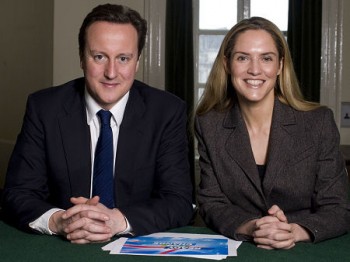
In Louise Mensch, David Cameron loses one of his brightest young Tory stars
News that Louise Mensch has resigned to spend more time with her family (a phrase that in this instance doesn’t mean “I was pushed out” but that she wants to live in the same city as her husband and spend more time with her children as well as perhaps grow her newly launched social network) has ignited discussions around work life balance and the role of women in politics again.
And unfortunately it’s stirring up some of the same old tired commentary.
Why did she become an MP if she was just going to leave? some say. Others criticise her ability to manage her responsibilities and insist it makes all working women look bad — although she’s the only popular writer turned Tory MP married to band manager who lives in New York that I know.
Certainly if moneyed working women like Louise Mensch have trouble managing, it does make you wonder how women in more modest circumstances manage. Through sheer grit and lots of trade-offs is how, often with unsatisfactory results. I don’t know a parent alive who wouldn’t like to spend more time with their children, especially if it didn’t impact their career.
But we’d be foolish to try to extrapolate lessons from Mensch’s personal choices.As Rachel Sylvester points out in The Times, her decisions as well as her circumstances are personal and unique. They involve love and two successful careers and an international long-distance relationship.
What this is instead is the perfect opportunity for us all to move on – move on from dissecting individual women’s choices (in Mensch’s case: should she have had a nanny? Should she have boarded the children? Should she have spent fewer days in the constituency? Why didn’t her husband move here?).
We should also move on from thinking we can do it all, all the time. Nobody can, male or female, mum or dad. Everyone makes compromises and this is hers.
This is, however, an opportunity to look at the culture of Westminster and beyond, and ask if there are ways to make our workplaces more modern, more appealing to dynamic people who happen to have children.
Sadly, it seems that the idea of juggling family and career in the Houses of Parliament is still considered a uniquely female problem. (Former Tory MP Edwina Currie said on Woman’s Hour that arrangements such as flexible working like Mensch enjoyed are a kind of discrimination for women; she also insists Mensch did let our side down.)
It all looks at working women through a prism of sexism and judgement.
“If she can’t do it, why not?” the thinking goes. “If she’d just sort herself out, it would work.” Things are fine the way they are, these folks assume, and we’re not going to change them for some woman.
Why should we make Parliament work more to the hours of MPs who want to spend their evenings at home rather than hanging out at the bar waiting for a vote?
Why should we make allowances for politicians to spend time with children (because of course, that’s what their wives are for).
Why should we consider whether our ideal expectations of work and parenthood create unworkable demands on both men and women?
Louise Mensch is moving on from her MP job. It’s time that the discussion about the pressures on working parents move on as well.

About Jennifer Howze
Jennifer Howze is the Creative Director and co-founder of BritMums. She blogs about family travel at Jenography.net, tweets at @JHowze and Instagrams at @JHowze. Previously, she wrote the Alpha Mummy blog at The Times and as a journalist has contributed to The Times, The Guardian, The Independent, The Wall Street Journal, Travel & Leisure, Budget Travel, CNN.com, Allure, SELF and Premiere, among others. She won The Maggie Award from the Planned Parenthood Federation of America for a health article in Seventeen magazine.
Heather
Wednesday 15th of August 2012
I totally agree with the whole work-life balance area being entirely personal. I gave up a well paid job to run my own business so I could spend more time with the kids and not commuting. Most of my former colleagues thought I was mad but I've never regretted it. However, while I don't think Mensch's choices should be put into the whole 'working women' debate, I do think that, as she stood at the last election 2 years ago, she should at least have committed to it for 5 years. That has nothing to do with her being a woman or having kids so they shouldn't be part of the discussion - although she's made them part of the discussion by citing them as her reasons for quitting. She has failed her constituents by not having the commitment to stay the 5 years they elected her for. And she has spent a hell of a lot of time on self promotion and not all that much on being an MP from what I can make out.
Jennifer Howze
Wednesday 15th of August 2012
Hi Heather, good talking point regarding fulfilling commitment to her constituents. Thanks for commenting.
jontybabe
Tuesday 7th of August 2012
I think that the choices people make regarding family and career are personal to them and we should not criticise until we are in their shoes. I am a social worker and I worked very hard to get my job and maintain a work/family life balance but I'd give it all up if I could to spend more time with my family. Does this make me a failure? I think not!
Jennifer Howze
Tuesday 7th of August 2012
Jontybabe
I hear ya. It is all about the personal choice. It's a function of our society that nobody goes around asking men whether they would like to give it all up to spend more time with their kids. And mostly this is an academic question - so many families need both incomes to survive.
That said, work/life balance is a woman thing or a man thing - it's a people thing - I hope my post went some way to making that clear.
Doug Daniel
Tuesday 7th of August 2012
"As Rachel Sylvester points out in The Times, her decisions as well as her circumstances are personal and unique. They involve love and two successful careers and an international long-distance relationship."
Those circumstances are hardly ideal for someone who is meant to be serving constituents, even without children involved in the mix. By trying to become an MP, you're making a commitment to your constituents. You're saying "vote for me and I will represent you for the next five years". You're not supposed to be saying "vote for me so I can get my face on some prime time TV programmes, launch a new social media website off the back of that new-found fame, and then sod off over to America after a couple of years when things are getting a bit too tough and the public tide has turned against me."
Two years ago, she asked people to put their trust in her as their elected representative. Now she's basically gone "meh, this isn't as fun as I thought, I'm bored of this now." My local MP does not have a husband living in a different country, doesn't spend half her time appearing on TV programmes, and doesn't have multiple careers. As a result, she's been able to serve as my MP for 15 years now, without even a hint of wanting to give up to "spend more time with family."
Maybe if people treated being an MP with the respect it deserves - and not as a part-time job alongside their main career or even as a mere PR tool - they wouldn't find it hard to keep it up? And rather than using the age-old "spending more time with family" excuse, why doesn't she just admit that it was daft to think she could be an MP while her husband (or boyfriend as he was when she was elected) lived on the other side of the Atlantic?
(Incidentally, why can't her husband be the one to give up HIS job and come over here to look after the kids?)
Jennifer Howze
Tuesday 7th of August 2012
Hi Doug,
Thanks for the comment. All the things you mention could make the entire work/family/life balance more difficult.
You have criticisms of her choices. We might argue or disagree about what she should or shouldn't have done, including whether she should have been an MP in the first place. I still maintain that those are individual and specific to Mensch and shouldn't be taken as some kind of lesson for the rest of us.