
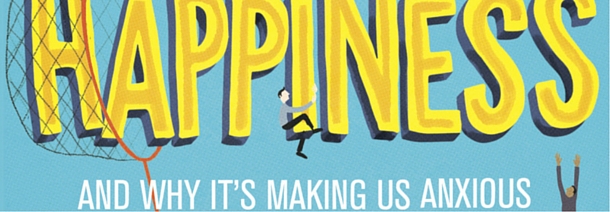
 I really wanted to like this book. The whole idea of the act of chasing happiness having the adverse affect intrigues me. After all, who doesn’t want to be happy? Aren’t we all on that journey?
But I found the author got in my way. Having spent half my life in the US, her sweeping generalisations about “American” parenting immediately put me on the defensive. The ease with which she labels an American way of doing things as a “problem” is overly simplistic. Additionally, describing it as a uniquely American problem ignores examples of this type of behaviour in the UK and beyond.
Parts of the book drew me in. I was interested in the Mormon view of happiness, and agreed with the idea that we are raising children in an age of indulgence and that protecting them from experiencing negative feeling is just putting off problems that will plague them later on in life.
But each time I found something that I liked about the book and could connect with, I’d run smack into sentences that seemed crafted for Daily Mail headlines rather than serious thought, lines like “Is this Great Search for Happiness creating a nation of nervous wrecks?” and “What is driving this frenetic edge to American parenting?” Could we just take out the word American?
I know plenty of parents in Henley-on-Thames, where I live, and leafy south London that circle over their children like overzealous Secret Service agents, who post “happy” pics of their kids on Facebook. In the UK, people couch these observations in self-deprecating terms but aren’t they simply replicating this “American” phenomenon with a British flair?
I found the chapter about having to pay dearly for any meaningful early childhood education/experiences just not true. Yes, the British government pays for preschool from age 2 (though going as young as 2 is a relatively new thing). But there are plenty of “free” options in the US. There’s a whole network of playgroups (Las Madres, for example) I don’t think the author tapped in to.
Did I like the book? I found parts interesting. Would I recommend it to friends? Yes, for those interested in a different perspective on modern life and who are skeptical about the breathless pursuit of “happiness” as a panacea for the stresses of life. Like me, they may find sections that resonate as well as other other parts they take exception too.
We could talk about it over coffee or cocktails. Come to think of it, that would make me happy.
Did you like the book or do you have views about the pursuit of happiness? Leave your link or comments below.
Please link up your review below.

About Susanna Scott
Susanna Scott founded the BritMums social network in 2008 after a career in marketing. She wanted to create a space for parent bloggers to network, and share ideas and opportunities. She is often quoted as a pioneer in the UK Mum Blogging space, and has been named a top female entrepreneur. She has been featured in The Times, The FT, The Independent, The Guardian, The Sun, Technorati, She, Primo Baby and Red magazine, amongst others. She speaks frequently about blogging, social networking and the BritMums community at industry events. Her blog A Modern Mother ranks in the UK’s top 10 Family Tarvel Blogs. Follow her on @amodernmother.
- Web |
- More Posts(191)
Nisha
Wednesday 8th of June 2016
I had no idea pursuing happiness was such a big industry until I read this book. Some bits annoyed me but on the whole it was a very interesting book. I'll be posting and linking my review on this book soon.
Rebecca Beesley
Wednesday 25th of May 2016
how interesting to hear your perspective on the cultural comparisons / differences. I think the author had decided her story from the outset and wrote a book to match the conclusion she wanted to find. Nonetheless I did enjoy it overall.
Maddy@writingbubble
Monday 23rd of May 2016
I've finally posted my review of this book - I found it fascinating! I didn't necessarily agree with the author on everything but, in the main, I liked her style and found all her discoveries really thought-provoking.
Pinkoddy
Wednesday 11th of May 2016
I really enjoyed this book and the style it is written in. I super appreciate Ruth's interaction with me on Twitter whenever I wanted to talk about a section of it. It was hard not to like even the bits I didn't agree with (We have done attachment parenting for example). I think her point was that everyone does happiness differently and we aren't always happy all of the time, some of just pretend - so stop trying to have someone else's happy and just enjoy your own (whatever that may be).
Reah Marshall
Sunday 24th of April 2016
I requested a copy of this book as I, like everyone no doubt, is on an endless pursuit of happiness.
I joined a yoga class, wrote a happy list (which includes a 'stop saying yes to things you don't want to do' policy) and promised myself I'd read more. So when the chance to look over this book came along I thought - this is just what I need.
I found myself chuckling at Ruth’s references to ‘mindfulness’ - as this is a discussion I have been having with my friends recently - in that my life/my head space is more ‘mind full’ than ‘mindful’ and I really need to cleanse it.
Here’s an early extract which really made me laugh;
‘…that our foremothers spent their days in a state of total mindful focus on their children is a myth. The desperate need to escape the grinding reality of childcare was surely as strong for our Mothers’ generation; they just used Valium instead of iPhones!’
Anyway I’m halfway in and I’m rather enjoying it. In fact, I haven’t really put it down, which is always a good sign. Looking forward to the rest of the book!